Pair a walkable seaside town with Mycenae and Epidaurus, then decide whether the rest of the Peloponnese needs its own journey.
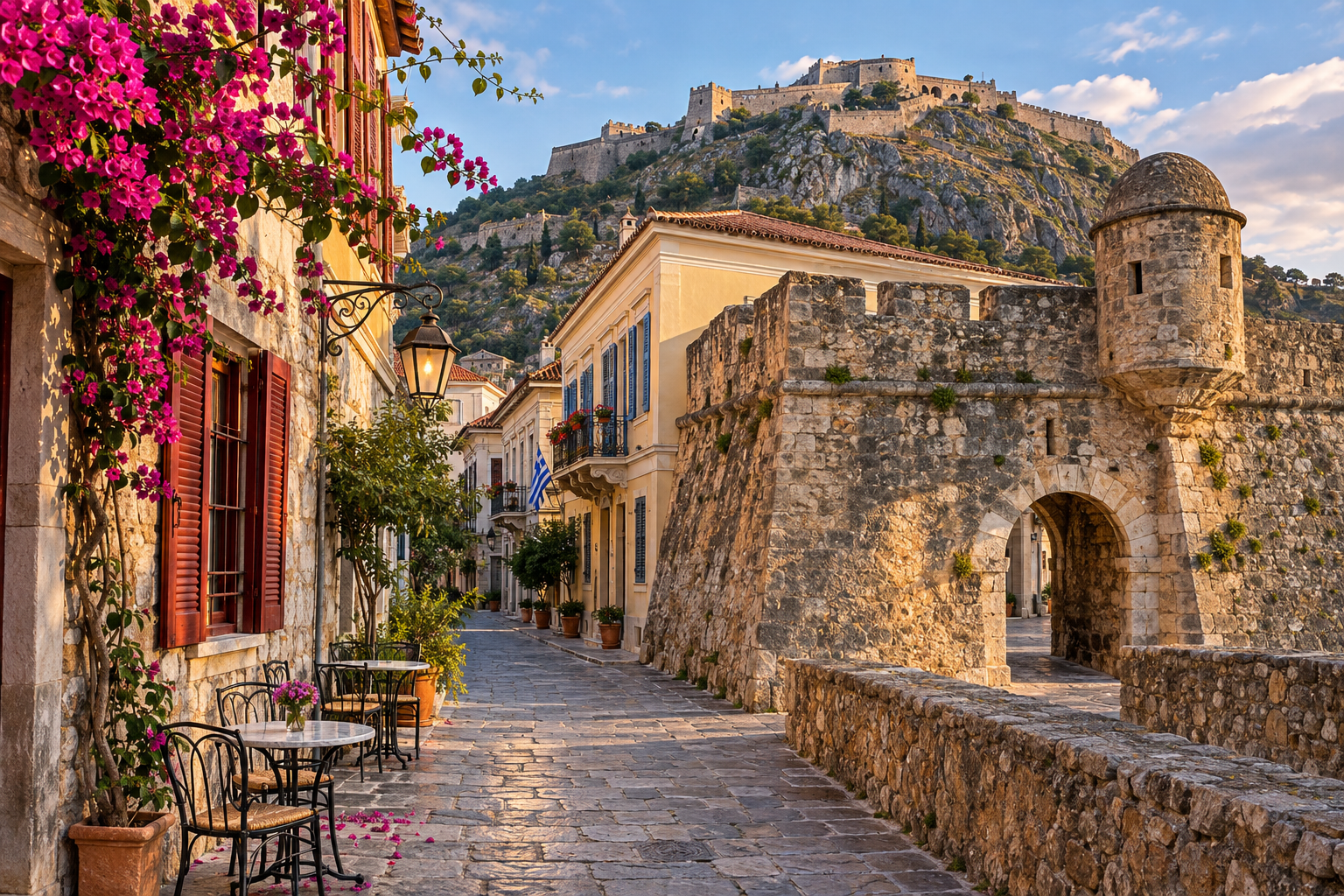
The Peloponnese is too large and varied to be represented by a single day on the road. For a first introduction, begin with a smaller region: the Argolid. Nafplio makes a compelling base because the town is worth returning to after an excursion. Its waterfront, old streets, fortifications, and squares give the trip an evening life, while Mycenae and Epidaurus provide two very different encounters with the ancient world.
Three nights allow a manageable first route: an arrival day in Nafplio, a day shaped around Mycenae, and another around Epidaurus. Add time if you want beaches, longer meals, or a deeper look at the town. This is particularly useful after a city stay in Athens, when another itinerary made entirely of major sights can feel more demanding than rewarding.
Arrive into the town, not the checklist
Make the first afternoon a Nafplio afternoon. Syntagma Square provides a natural center, with streets leading toward the waterfront and the older fabric of the town. Look for the relationship between open squares and narrow lanes, then walk to the sea. The Bourtzi fortress sits offshore, while the fortified height of Akronafplia forms a different edge to the old town.
Nafplio's importance also belongs to modern Greek history: it served as an early capital of the independent Greek state. That context gives the town more substance than its attractive facades alone. The Archaeological Museum in Syntagma Square can introduce the region before you see its ancient sites, provided you allow the visit a real place in the day.
If arriving by car, solve parking before entering the tight old-town streets. A base within walking distance of evening meals can reduce short drives and make returning from excursions easier. Travelers arriving by bus can enjoy Nafplio itself comfortably, but should plan archaeological day trips separately rather than assuming every site has a convenient direct connection.
Give Mycenae the weight of a main visit
Mycenae lies north of Nafplio and belongs to a much earlier world than the classical temples many visitors first associate with Greece. The citadel, Lion Gate, monumental walls, and nearby tombs make this a visit about scale, power, and the difficulty of reading a distant past from surviving stone.
Allow time for the museum as well as the open site. Objects and interpretation help connect the visible foundations to the lives and structures they once contained. The Treasury of Atreus, a monumental tholos tomb near the citadel, deserves a deliberate stop rather than a rushed glance through a car window. Myth and archaeology meet here, but they are different kinds of evidence; a familiar name from the Trojan stories is an invitation to ask questions, not proof that every traditional identification is literal history.
The site is exposed and uneven in places. Plan around the season, wear suitable shoes, and avoid treating a hot afternoon as the inevitable slot left after every other activity. If you want a second ancient site, Tiryns offers another perspective on Mycenaean fortification nearer Nafplio. It is a logical option for a traveler with sustained interest, not a compulsory addition after an already full visit.
Understand Epidaurus beyond the theater
The great theater is the most recognizable image of Epidaurus, but the wider Sanctuary of Asklepios is essential to understanding the place. This was a setting associated with healing, with religious, social, and architectural dimensions. Give the surrounding remains and museum attention, so the theater becomes part of a larger story.
Distinguish the sanctuary from the coastal settlement of Ancient Epidaurus when navigating. Similar names can create a practical misunderstanding, particularly when arranging transport or choosing a meeting point. If you add time by the coast, describe the destination clearly and leave enough margin to enjoy it rather than fitting it into a narrow gap.
A performance at the theater can be a powerful reason to shape a trip around a particular evening. It is also a separate logistical commitment: confirm the actual event, ticket, and return journey. A daytime archaeological plan does not automatically solve travel after a late performance.
Save a morning for Nafplio's heights
Palamidi, the fortress above the town, repays time with its architecture and its views over the Argolic Gulf. The stepped ascent is strenuous, particularly in heat; approach choices should match your fitness and mobility. Do not make a stair count into a test of whether you have properly visited Nafplio. Reaching the site by road still involves understanding conditions and access within the fortress.
Akronafplia offers a different, closer relationship with the old town's fortified landscape. Choose one substantial uphill outing if that is enough for the day. Returning to the waterfront afterward gives a satisfying change of scale, and a free afternoon can be more valuable than another drive.
Know when the region becomes another trip
Mystras, Monemvasia, the Mani, Ancient Messene, and Olympia all belong to the Peloponnese, but that shared label does not make them casual additions to a Nafplio base. Mountain roads, different coastlines, and the time each place deserves argue for a longer circuit with new overnight stops.
Use Nafplio to learn how you like traveling on the mainland. If a walkable base and a carefully chosen excursion suit you, Meteora offers a very different landscape with a similar argument for staying overnight. If you want to continue west or south, build the next section as its own journey. A focused Argolid visit is already a complete trip, not an incomplete version of the entire peninsula.