Build an island stay around three different landscapes instead of spending each day chasing another beach.
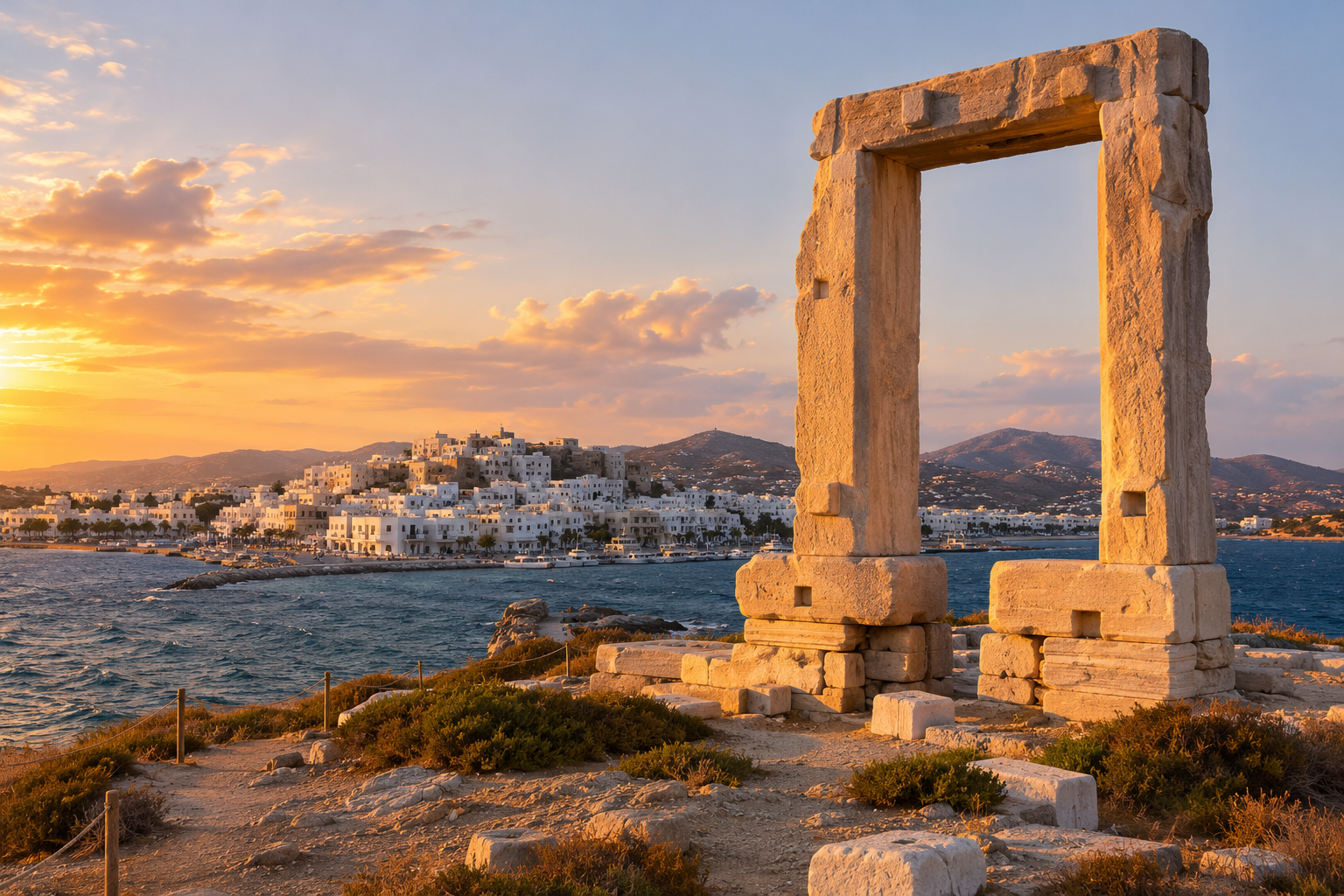
Naxos offers a useful antidote to an island itinerary built only around arrival ports and sunset photographs. Its main town, west-coast beaches, and inland villages form three distinct experiences, while the mountains give the island a scale that is easy to miss from the harbor. Four or five nights provide time to combine them without changing accommodation every day.
Begin with Chora, the island's main town, then choose one beach area and a considered route inland. This is a good first Cycladic stay for travelers who want both a recognizable seaside setting and a working agricultural interior. If your trip also includes Athens, the contrast comes from the pace and landscape as much as from the sea crossing.
Read the town from the harbor upward
The Portara, the monumental marble doorway on the small headland beside the harbor, gives arrivals a memorable landmark. It is the surviving entrance of an unfinished ancient temple, a fragment whose open frame makes the sea and sky part of the view. Visit when it fits your day rather than assuming sunset is the only worthwhile moment. Wind, spray, and crowded footing can change the comfort of the walk across the approach.
Then move into the town behind the waterfront. Chora rises toward the Kastro, with lanes, steps, passages, and buildings that reveal a more enclosed side of island life. Walk upward slowly and accept a few wrong turns, while respecting residential entrances and private courtyards. The waterfront is useful for orientation and transport, but it is only one face of the town.
Agios Georgios, beside Chora, offers an easy change of scene without making the first day depend on a vehicle. Its proximity is especially useful after a journey, when a short walk, a swim in suitable conditions, and a nearby meal may be more appealing than an immediate tour of the island.
Choose your beach base before choosing every beach
The west-coast sequence around Agios Prokopios, Agia Anna, and Plaka gives visitors several ways to organize time near the sea. Compare the actual setting around the accommodation: access to food, distance from the sand, road crossings, and the ease of returning to Chora. A place described with the same broad beach name can still sit in a quite different position from another property.
You do not need to move along the entire coast in a single day. Spend a morning in one area, learn where shade and food are available, and decide whether the next stretch adds something you want. Beach quality is also a question of conditions and needs: wind exposure, waves, supervision, and access matter more than a universal ranking.
Summer bus connections can make a stay without a car practical along established corridors, but services vary by season and route. Confirm the actual return options for your dates. A car can help with inland stops, yet keeping it parked for beach days may be the most comfortable use of it.
Give the interior its own full day
Halki, Filoti, and Apeiranthos belong to a coherent inland journey, but each offers a different reason to stop. Halki, in the Tragea area, has a compact center and a landscape shaped by olive cultivation. Filoti sits beneath the island's mountain country, with a lively village center and a stronger sense of the scale behind the coast. Apeiranthos has a distinctive stone-built setting and marble-paved lanes.
If driving, place these stops in a sensible road sequence and leave time for lunch in one village. If traveling by bus, plan around the actual service rather than trying to recreate a car itinerary with a succession of uncertain connections. Two villages visited well are more useful than three glimpsed while watching the clock.
Village visits are also an opportunity to eat beyond the harbor menu. Ask about local cheeses and seasonal dishes, and notice the agricultural landscape that supports them. Avoid treating the interior as an untouched contrast to a supposedly inauthentic coast. Both belong to contemporary Naxos, with tourism, daily work, and changing local needs.
Add archaeology or walking as a deliberate choice
The Temple of Demeter near Sangri introduces an archaeological chapter away from the Portara and Chora. It is a useful choice for someone interested in how ancient sanctuaries relate to rural settings. The unfinished kouros statues in the Melanes area offer another encounter with Naxian stone and ancient sculpture. Choose according to your route and interests rather than adding every ancient site to the same day.
Mount Zas is a separate walking objective. A village excursion does not automatically prepare you for a mountain ascent: route choice, weather, water, sun exposure, and suitable footwear all matter. If the summit is your aim, make it the day's main activity and seek reliable local route information. There is no need to turn a relaxed inland drive into an unplanned hike.
Leave breathing room around the crossing
Ferry journeys shape island time. Select connections for the dates you need, allow for weather disruption, and leave a sensible buffer before a flight that cannot be missed. Traveling between islands because they look close on a map can introduce an awkward route or an unnecessary change; verify the service before committing to the next accommodation.
For a shorter stay, keep Chora, one west-coast beach, and one inland outing. With a longer visit, repeat a place you enjoyed before expanding the map. Travelers looking for a larger regional journey can compare western Crete, where mountain distances and multiple city bases create a different planning problem. On Naxos, the most satisfying plan often gives the town, villages, and sea a full day each, then lets the remaining time belong to the island.